Is a car safe in a lightning storm?
A hard-topped car is one of the best shelters you can reach outdoors. The reason is the metal shell, not the rubber tyres, and it matters for what you should touch.
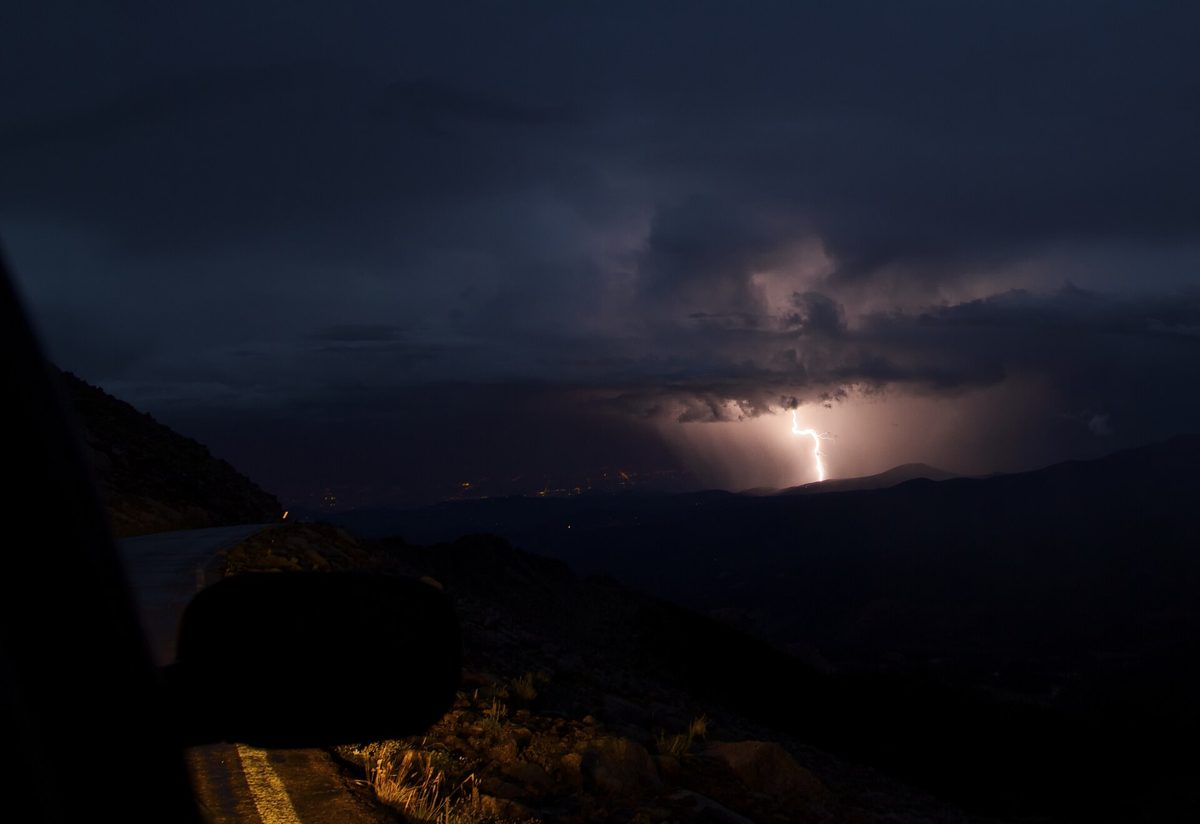
Yes, a hard-topped car with a metal body is a safe place to be during a thunderstorm, and the US National Weather Service lists it alongside a substantial building as the shelter to reach. The reason is not the tyres. Four inches of rubber do nothing against a bolt that has just crossed a kilometre of air. The reason is the metal shell around you, which behaves as a Faraday cage: the current flows through the body of the car, around the passenger space, and to the ground through the wet tyres and the arc from the axle.
What happens when lightning hits a car
Lightning usually strikes the roof or the aerial. From there the current runs through the metal body to the lowest point and jumps to the ground. Inside the cabin the electric field is close to zero because the charge stays on the outside of the conductor, which is what a Faraday cage does. Typical damage: a pitted roof, blown tyres, fried electronics, sometimes a burnt patch of paint. Occupants are usually unharmed, provided they were not touching the shell.
What to do inside the car
- Pull over somewhere safe, away from trees and power lines, put the hazard lights on and stop. Heavy rain and hail make driving the greater risk.
- Close the windows and keep your hands off metal: door handles, the gear lever, the radio, the ignition key.
- Sit with your hands in your lap. The current will take the outside of the car, not you, as long as you are not part of the path.
- Wait 30 minutes after the last thunder before getting out, the same rule as for any shelter. See how far away the lightning is.
Vehicles that do not protect you
The protection comes from a continuous metal shell, so it is missing where the shell is missing:
- Convertibles with the roof down, and soft-tops in general.
- Fibreglass or carbon-fibre bodies, including many kit cars, some sports cars and most motorhome bodies.
- Motorcycles, bicycles, golf carts, open tractors and ride-on mowers.
- Tents and gazebos, which offer no protection at all.
Aluminium-bodied cars are fine; aluminium conducts as well as steel for this purpose. Electric cars are fine too; the battery pack is inside the same metal structure and manufacturers test for strikes.
Is a car safer than a house?
A substantial building with wiring and plumbing is the safest place, because the strike has many paths to ground. A car is the next best. What a car beats is everything outdoors: an open field, a beach, a boat, a picnic shelter or a tree, which is the most dangerous shelter of all because the current comes down the trunk and out through the ground where you are standing.
Planning around storms
Thunderstorms are the least predictable part of a forecast: the models can say a day is favourable for storms without knowing where each cell will form. On our city pages you can see whether the five models agree on storms for the afternoon; on the radar you can see the cells that already exist and which way they are moving. If you are driving into a storm, the radar is the better tool.